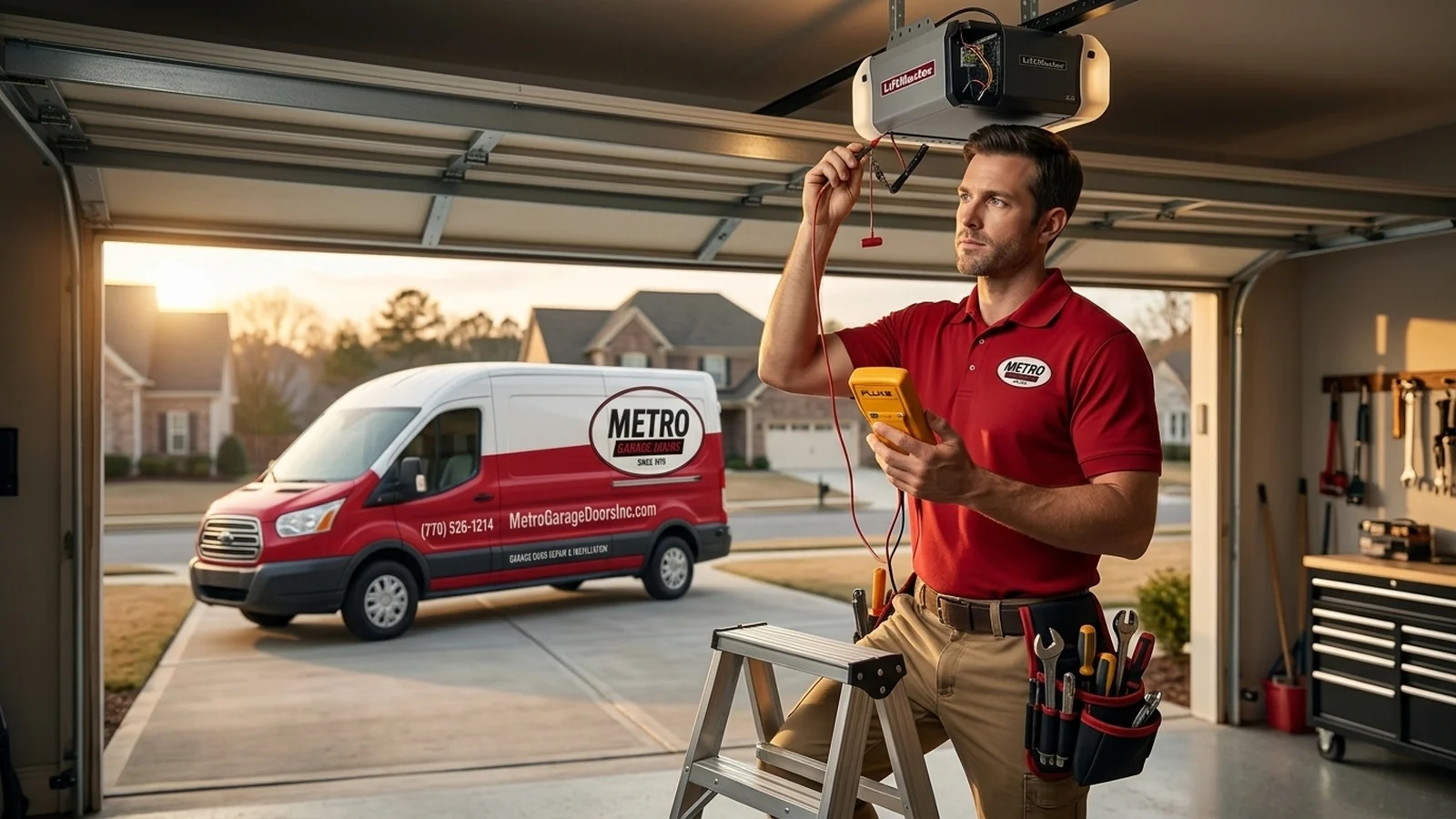
LiftMaster 8160W chain-drive — the workhorse. Mounts on the ceiling, drives the door via a steel chain running along a center-mounted rail. Loudest of the three (the chain noise carries through walls), most reliable (proven mechanism, easiest to service), and the entry tier of the Elite line. Best for detached garages, garages where noise isn't transmitted into living space, or houses with a separate primary access door so the garage opener noise doesn't disrupt sleep. 5-year motor warranty. Roughly 15-year typical lifespan at residential use.
LiftMaster 8550W belt-drive — the quiet one. Same ceiling mount and center rail as the chain-drive, but uses a reinforced rubber belt instead of metal chain. Roughly 70% quieter than chain in operation — most homeowners describe it as "barely audible." Best for any garage with a bedroom, office, or living space adjacent or directly above (bonus rooms over garages are a common Atlanta floor plan). Lifetime belt warranty, 5-year motor warranty. ~15-year typical lifespan.
LiftMaster 8500W jackshaft side-mount — the premium. Mounts on the wall next to the torsion shaft (NOT on the ceiling, NOT a center rail). The ceiling stays completely clear — perfect for storage racks, overhead bins, kayaks, or anywhere you want to use the garage ceiling for storage. Also essential for low-headroom historic garages (Atlanta bungalow neighborhoods, Roswell historic district, downtown Marietta) where ceiling-mount openers physically won't fit. Quietest of the three, includes battery backup standard, includes deadbolt-style automatic door lock. Lifetime motor warranty. ~20-year typical lifespan.
What every install includes. The opener itself, full installation labor, two LiftMaster remotes, wall console (smart wall console with myQ display on Elite models), safety-sensor pair, motor-end mounting hardware, header bracket if needed. Programming includes setting upper and lower travel limits, calibrating force settings (door auto-stops if it hits something during close), pairing remotes, programming the wall console, connecting to your home Wi-Fi for myQ, and demonstrating operation + manual disconnect for emergencies. Optional add-ons: battery backup module (recommended for Atlanta storm season), myQ Home Bridge for HomeKit integration, additional remotes, and dedicated wireless keypad for outside the garage. Each add-on quoted on the same written estimate.
Our install process. Remove the old opener (motor unit, rail, chain or belt, header bracket if changing drive type) — typically 30 minutes. Assemble new opener and mount header bracket. Hang motor unit from ceiling joists (or wall-mount for jackshaft). Run rail and thread chain or belt. Hardwire 110V power and program the safety sensors near the floor. Set up-down travel limits and force settings. Pair remotes and wall console. Connect myQ to home Wi-Fi (yours, with your password) and walk you through the app. Test 5–10 cycles to verify settings hold. Demonstrate operation + emergency manual disconnect. From arrival to handoff: 90 minutes to 2 hours for chain or belt-drive; 2 to 2.5 hours for jackshaft side-mount due to wall-mount alignment.