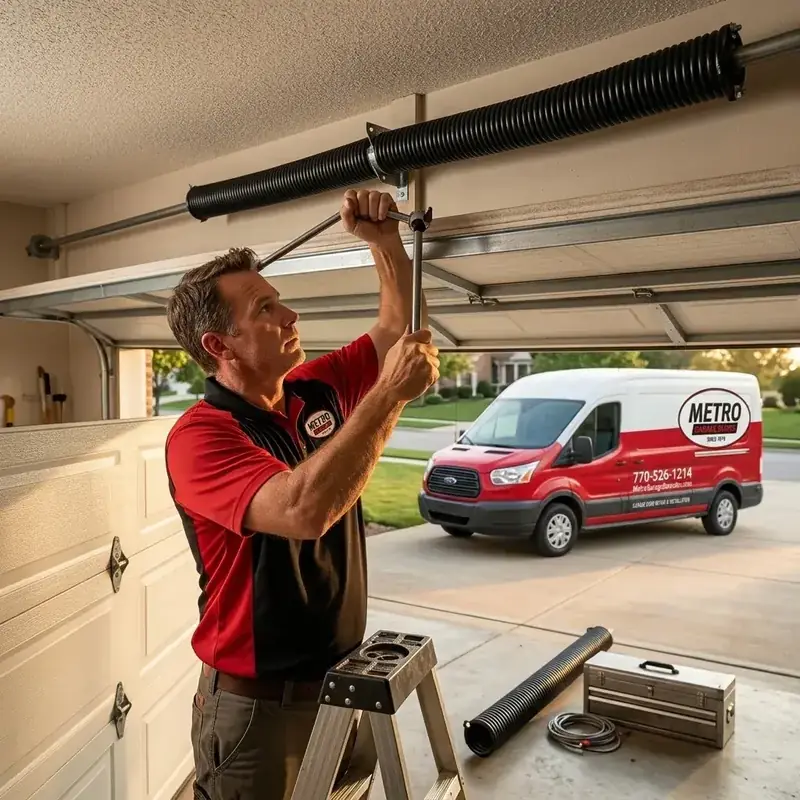
What lift cables actually do. Two galvanized steel cables run from the bottom corners of your garage door up to drums mounted on the torsion shaft above the door. As the spring twists the shaft, the drums wind the cables up and lift the door. The springs do the work; the cables are the linkage. Lose a cable and the door drops on one side, twists the panels, and either falls or wedges in the tracks. Standard cables are 7x19 stranded galvanized steel, roughly 1/8 inch thick, rated for the door's weight plus a safety multiplier.
Why both cables always go in pairs. Same reason as torsion springs — the second cable has identical age, identical Atlanta humidity exposure, identical cycle count, and identical fatigue as the broken one. It's typically weeks or months behind on its own failure timeline. Replacing only the broken cable means a second emergency call inside the year, plus the door operates with mismatched cable tension in between (which puts uneven load on the spring system and the opener). Industry standard for any garage door tech who isn't trying to milk return visits.
What causes Atlanta cable failure — three culprits. First, humidity-driven corrosion. Standard galvanized coatings degrade faster in moist garage environments — Lake Acworth and Lake Allatoona waterfront homes can lose a cable to rust in 5–7 years vs. the 10–15 year inland average. Sweetwater Creek and tree-shaded properties (Roswell historic district, Inman Park bungalows) sit in the middle. Second, spring-failure cascade damage — when a torsion spring snaps, the cable on the same side often takes shock damage and may fray weeks or months later. Third, worn cable drums: the grooved spools the cables wind onto develop sharp edges over years and cut the cable strand-by-strand. Roller misalignment and off-track door operation can also cause cable abrasion.
The lake-area galvanized upgrade. Lake-adjacent homes (Acworth, Lake Allatoona, Sweetwater Creek waterfront, Vinings backing the Chattahoochee) get our heavier marine-grade galvanized cable by default — 2–3x the corrosion lifespan in humid conditions. No extra labor, no extra cost. We've been doing lake-area cable work since 1979 and the spec exists because we got tired of going back to the same houses every 5 years for the same standard-cable failure.
Our process. Block the door with vise grips, support the door panels, release torsion-spring tension carefully, remove old cables from the bottom-corner brackets and from the cable drums, inspect the drums for sharp edges (replace if worn — quoted on the same written estimate), thread the new cables, wind torsion back to spec, run the door 5–10 cycles to verify cable seating, lubricate moving parts with silicone. From arrival to handoff: typically 45–60 minutes for a single-door, 60–90 for a double.