What rollers do. Each garage door has roughly 10–14 rollers spaced along its edges — typically 2 rollers per panel on each side, plus top and bottom. Each roller sits in the metal track running along the side and overhead of the garage. As the door opens or closes, the rollers carry the door's weight along the tracks. The opener provides the force, the springs provide the lift assist, but the rollers are the actual moving contact between the door and the structure. Worn rollers grind, bind, and transfer noise straight into the house.
Steel rollers — the cheap default. Most builder-grade and big-box-store doors ship with steel rollers — a small steel wheel on a steel-shaft hub, no lubrication seal. They're the cheapest option to manufacture, last roughly 5–10 years in typical use, less in Atlanta humidity (lake-adjacent homes, dense tree canopy, attached garages under humid laundry rooms cut that to 4–6 years). When steel rollers wear, the wheel develops flat spots, the hub bearing seizes, and the assembly grinds metal-on-metal in the track. Common symptom: door is louder than it used to be, opener sounds strained, occasional bind or shudder during travel.
Nylon high-cycle rollers — the upgrade. What we install on virtually every roller replacement: a hard nylon outer wheel on a sealed precision ball-bearing hub. The nylon wheel rolls smoothly on metal track without metal-on-metal contact, the sealed bearing keeps moisture and grit out, and the assembly lasts 15–25 years even in humid Atlanta conditions. Door noise drops 60–80% immediately after the swap — most homeowners describe it as "I can barely hear it now." Best bang-for-buck noise reduction we can do short of upgrading to a belt-drive opener.
Why we replace the full set, not individual rollers. The labor's the same either way — we have to detension the door system to access any roller. The individual roller cost is small compared to the labor of a return visit. And the rollers all have identical age, identical use, identical Atlanta humidity exposure — the unworn ones are typically months behind their failed siblings. Full-set replacement also lets us spec consistent nylon rollers throughout the door, which gives uniform smoothness instead of mixing old steel and new nylon.
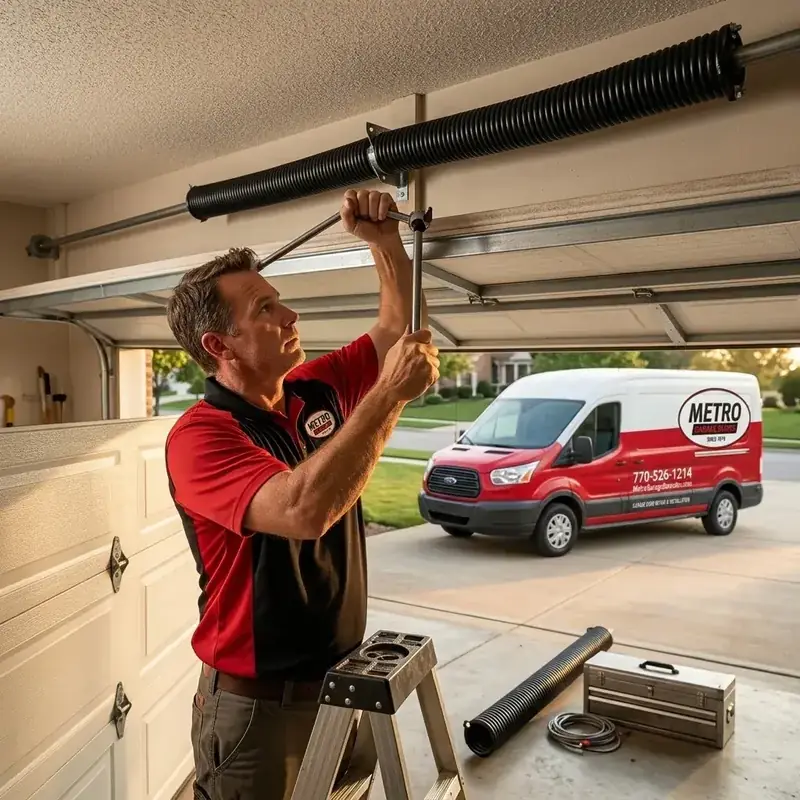
Our process. Block the door with vise grips, support the door panels, release torsion-spring tension carefully, remove old rollers from each hinge bracket starting at the bottom panel, install new nylon rollers (paying attention to roller-shaft length spec for your specific door — common is 4 inches), lubricate the bearings and the metal tracks with silicone, retension the springs, run the door 5–10 cycles to verify smooth operation. From arrival to handoff: typically 45–75 minutes for a single-door, 75–105 for a double. The noise difference is immediate and dramatic.