Repair vs replacement — the diagnostic line. A spring repair covers lubrication, tension adjustment, and balance work on a spring that's still intact and within its useful life — typically the first 8–12 years of a standard 10,000-cycle spring's lifespan. A replacement is a full pair swap when the spring has snapped, shows visible coil deformation, or is past its rated cycle limit. Most Atlanta homes need one or two spring-repair visits over the door's life before the first replacement becomes necessary — done right, that means the door operates quietly and safely for the full 10–15 years instead of squeaking for the last five and snapping on a cold morning.
The lubrication science — why silicone, not WD-40. WD-40 is a degreaser, not a lubricant. It strips the protective coating on torsion springs (especially the galvanized and oil-tempered finishes that resist Atlanta humidity), accelerating the corrosion it's supposed to prevent. After a few WD-40 applications, the spring rusts and burns through cycle life faster. The right product is silicone-based garage door lubricant — 3-IN-ONE Garage Door Lube, Blaster Garage Door Lubricant, or equivalent — applied along the coils, on the torsion-tube bearings, and on the rollers and hinges. Six-month interval is standard; lake-adjacent and high-humidity garages benefit from quarterly. Lithium grease is also wrong (collects dust + grit, accelerates wear).
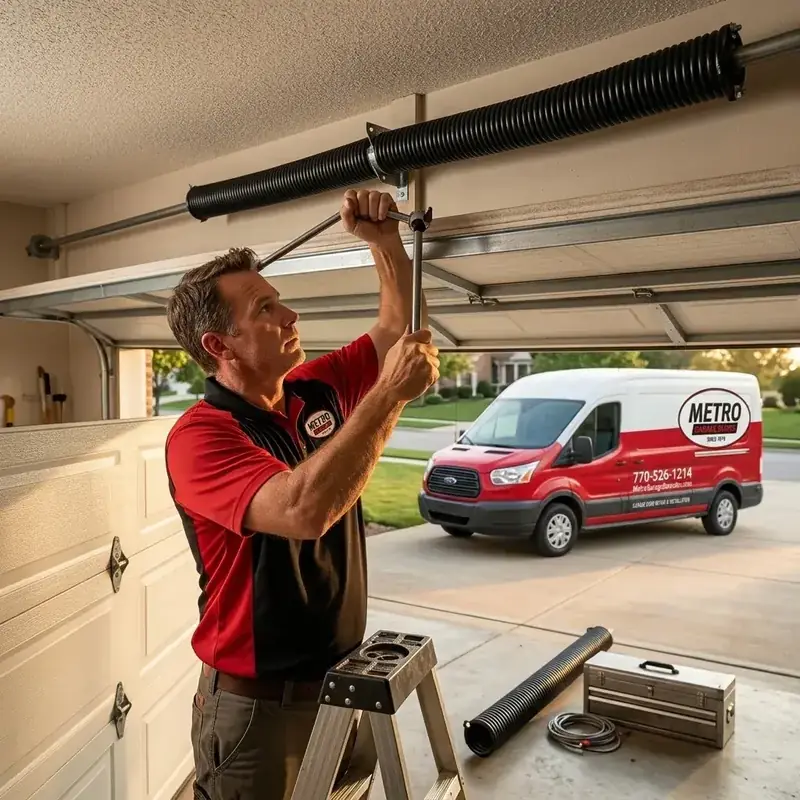
Tension adjustment — what "balanced" means and how it's measured. A balanced garage door holds mid-travel without the opener doing the work. Lift it manually halfway and let go — it should stay put. Drift down means under-tensioned springs; bouncing up means over-tensioned. We weigh the door (or pull manufacturer spec for your panel + insulation combo), calculate the correct turns of torsion (typically 7–9 quarter-turns from neutral for most residential doors), and adjust on-site with winding bars. After adjustment, we run the balance test before leaving. If the spring won't hold the new tension or the calculation pushes it past spec, that's the line where replacement becomes the better call.
The math — repair vs. emergency replacement. A repair call is meaningfully less expensive than a full pair replacement, plus you avoid the inconvenience of a stuck door (cars trapped, garage exposed, sometimes a same-day emergency premium at competitors). Most spring fatigue is detectable 2–6 months before failure — squeaks, heavy door, slow operation, balance off. Catch it on a repair visit instead of waiting for the snap. If our diagnostic reveals the spring is past its useful life and we recommend replacement, the diagnostic visit isn't separately billed if you proceed with the replacement same-day.
Our process. Visual inspection of both springs (coil condition, surface rust, gap from neutral), torsion-tube bearing check, cable tension check, balance test, then lubrication of coils + bearings + rollers + hinges with silicone. If tension adjustment is needed, we calculate to spec and adjust with winding bars. From arrival to handoff: typically 30–45 minutes for a single-door call, 45–60 for a double. The door operates noticeably quieter immediately, and the cycle-life clock resets on any tension we restored.